Portable Delsys Use
We have a Delsys system with a collection of sensors. Stand alone usage of this system is detailed on this page. Instructions for using with QTM can be found in the fourMs lab section.
Introduction to EMG
Electromyography Principles
Electromyography (EMG) sensors measure the muscle response or electrical activity in response to a nerve鈥檚 stimulation of the muscle. Simply, it describes the input into the muscular system. When a muscle contracts, a burst of electric activity is generated and propagates through neighboring tissue. These muscle activation patterns can be recorded by attaching an EMG sensor to the skin over the muscle belly. The signal captured by this technology is a measure of voltage over time.
The surface EMG measures this electrical signal on the skin superficially to the target muscle. This means that there are a lot of different body components between the target muscle and the sensor. For example, hair, skin oil, and lotion or makeup on the skin鈥檚 surface will affect the EMG signal. Additionally, muscles have different parts and orientations, so the sensor placement will also affect the signal.
EMG placement
Placing an EMG sensor requires a fair bit of anatomy knowledge. You need to find the target muscle and the optimal location on the muscle. It is important to target the belly of the muscle rather than the tendons. The sensor will record any electrical signals below the surface so that other muscles may be recorded. Even the heartbeat can be recorded using EMG sensors.
In addition to finding a good location, it is important to prepare the skin to maximize conductivity. This can be done by using alcohol wipes to remove oil and lotion from the skin. For older EMG systems, it was necessary to shave body hair. Newer technology is not as sensitive and can often be placed directly on the skin.
Knowing which muscles or muscle groups are measurable by EMG is also important to use the technology. Muscles that are closer to the surface are best, as larger ones can be palpated easily. Additionally, the sensor cannot inhibit movement, so placing it across a joint is a bad idea. This means that a muscle like the聽biceps brachaii聽is great because it is large and superficial. The聽iliopsoas聽muscle is poor due to its deep nature and location next to the hip joint.
The steps necessary to place an EMG sensor are shown in the image below and can be summarized as:
- Locate the muscle
- Palpate the muscle to find the muscle belly
- Clean the skin鈥檚 surface using alcohol wipes
- Attach the sensor
The EMG signal
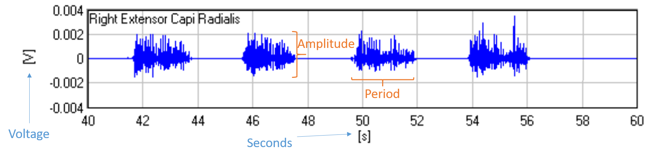
As shown in the image below, the EMG signal is reported in graphical form as a voltage over time. The聽amplitude聽is the height or amount of voltage and the聽period聽is the duration of the signal or cycle. The amplitude height refers to the amount of signal and the period is the quantity of time the muscle is activated.
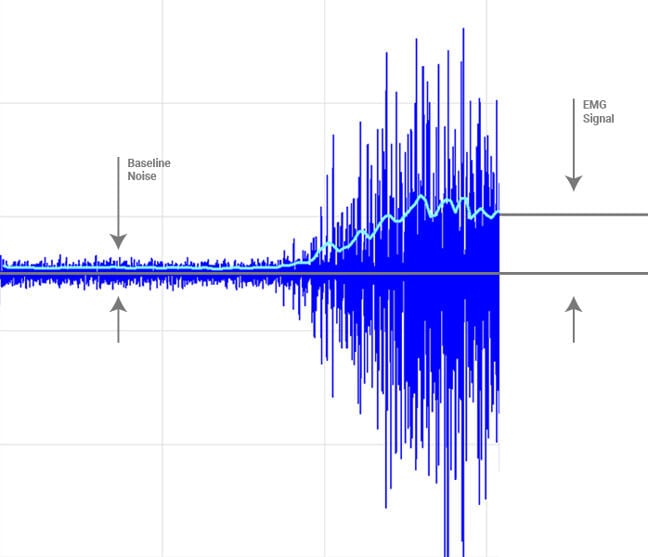
There is always a small voltage being sensed, even when the muscle is at rest. This is called the聽baseline noise聽and it makes it difficult to determine the exact time point that the muscle is activated (see figure below). Because of that, EMG data is used differently from other movement analysis data types.
Analyzing EMG data
There are a few important things to remember about EMG data. The first is that a large amplitude correlates to muscle contraction and not the strength of the muscle itself. The technology measures muscle signals and not the force of the muscle.
Another thing to remember is that muscles are not isolated. This means that muscles work together to accomplish a movement. They also share real estate within the body. That means the EMG signal will frequently have some noise from other muscles, and the movement will not be fully explained by looking at only one EMG signal.
Summing up
Learning how to use EMG takes time and practice. It requires practical knowledge of anatomy and a basic level of comfort with the resulting data signals. The best thing you can do is to practice!
Delsys EMGWorks
Kayla to write instructions